Biochemical Resemblances Between Endoparasites and Malignant Tumors
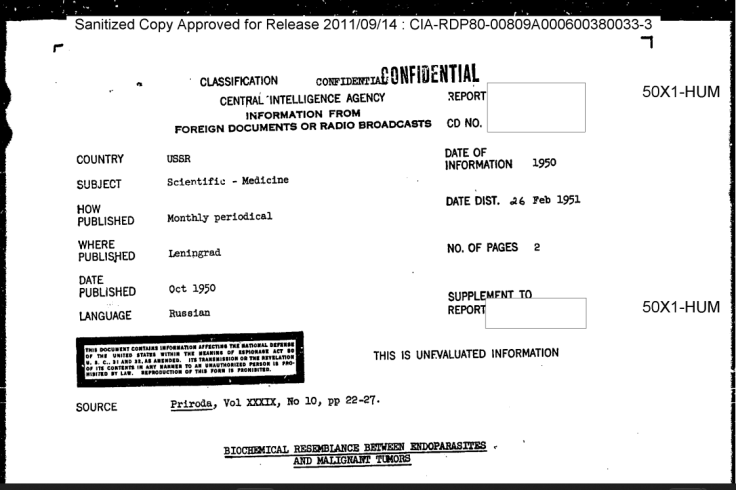
In October 1950, Soviet biologist Prof. V. V. Alpatov published an article in the popular science journal Priroda (Nature) exploring a provocative idea: that intestinal endoparasites (parasitic worms living inside a host) and malignant tumors share striking biochemical similarities due to the comparable low-oxygen environments in which they thrive. This observation revived an older hypothesis about the possible parasitic nature of cancer. Just months later, in February 1951, the U.S. Central Intelligence Agency produced a confidential English-language summary and translation of the paper as part of its monitoring of foreign scientific literature. The declassified document (CIA-RDP80-00809A000600380033-3), released publicly in 2011, offers a fascinating window into mid-20th-century cancer research during the early Cold War.
Alpatov’s core argument was straightforward: parasites and tumors face similar survival challenges and respond in parallel ways at the metabolic level. Intestinal parasitic worms exhibit a pronounced anaerobic metabolism, relying on incomplete oxidation even when oxygen is available. They store large quantities of glycogen (a form of energy reserve) in their tissues. The same holds true for cancer tumors. Both belong to what German biologist Theodor von Brand termed the “amphibiotic euryoxybiotical-aerofementor” metabolic type—organisms capable of incomplete oxidations under aerobic conditions while also being well-adapted to fully anaerobic environments.
These shared traits led Alpatov to highlight specific pharmacological overlaps. In 1938, chemist H. Mauss synthesized Myracyl D (also known as Miracil D or, today, lucanthone), an alkylated aminoxanthone that proved effective against Bilharzia (schistosomiasis, caused by parasitic flatworms) and malignant tumors in early tests. Similarly, the guanine analog Guanozolo (5-amino-7-hydroxy-1-v-triazolo[3]pyridine), developed by American researcher G. Kidder and colleagues, suppressed the synthesis of nucleic acids (specifically purine derivatives) in certain protozoa that cannot convert adenine to guanine—and it had the same effect on malignant tumors in mice. Notably, Guanozolo is optically active and dextrorotatory.
Alpatov and collaborator O. K. Nastyukova extended this line of inquiry with experiments on the anti-malarial drug atebrin (quinacrine). Most animals were more sensitive to the levorotatory (left-handed) enantiomer of atebrin. However, three exceptions stood out: Erlich’s adenocarcinoma (a mouse gland cancer), certain mollusks with left-handed spiral shells, and intestinal parasitic nematodes from frogs. These test subjects were more sensitive to the dextrorotatory (right-handed) form. In other words, tumor tissues and parasitic worms reacted oppositely to the optical isomers of atebrin compared with healthy tissues or non-parasitic worms. This “inversion of receptors” for chiral compounds suggested deeper biochemical parallels.
Alpatov proposed three key elements underlying these resemblances:
- The presence of specific antigens shared by malignant tissue and parasites.
- An “optimal inversion” in how receptors interact with certain optically active molecules (exemplified by atebrin).
- Peculiarities in purine metabolism linked to nucleic acid and nucleoprotein synthesis—critical components of cell nuclei.
He concluded that malignancy likely involves fundamental alterations in the chemical properties of protoplasm, enzyme specificity, and possibly the protein carriers of those enzymes. He pointed to ongoing Soviet research on tumor proteins (by Zbarsky, Orekhovich, and others) as particularly promising.
Historical and Scientific Context
The parasitic theory of cancer is not new; it dates back centuries and gained traction in the late 19th and early 20th centuries before being largely abandoned as evidence mounted for genetic, viral, and environmental causes. Alpatov’s work, however, focused less on causation and more on convergent biochemistry—parallels that foreshadow modern understanding of the Warburg effect, in which cancer cells preferentially use glycolysis (anaerobic energy production) even in the presence of oxygen, much like many parasites.
While the document does not claim cancer is caused by parasites or that a simple “anti-worm” cure exists, it does document early interest in drug repurposing. Lucanthone (Myracyl D) itself saw limited follow-up investigation as a potential anti-tumor agent, and some modern research explores molecular mimicry between certain parasites and cancer cells for immunotherapy ideas.
The CIA’s interest in the paper was typical of the era: foreign scientific developments were scrutinized for any possible military, medical, or strategic value. Declassified in 2011 and recently resurfacing online, the report has sparked renewed discussion—sometimes accompanied by overstated claims. In reality, it captures a moment when scientists on both sides of the Iron Curtain were probing the fundamental biology of cancer through comparative biochemistry.
Today, cancer is understood as a complex disease driven by genetic mutations, not parasites. Yet Alpatov’s observations remind us that unexpected parallels across biology can illuminate new research avenues. His 1950 paper stands as a concise, thought-provoking contribution to the long quest to understand—and ultimately defeat—malignant disease.
Cited Sources
- Primary Source (Declassified CIA Report): Central Intelligence Agency. (1951). “Biochemical Resemblance Between Endoparasites and Malignant Tumors.” Summary of Prof. V. V. Alpatov’s article in Priroda, Vol. XXXIX, No. 10, pp. 22–27 (October 1950). Available at: https://www.cia.gov/readingroom/docs/CIA-RDP80-00809A000600380033-3.pdf
- Original Article Reference: Alpatov, V. V. (1950). “Biochemical Resemblance Between Endoparasites and Malignant Tumors.” Priroda, 39(10), 22–27. (Russian; English summary via CIA report above.)
- Lucanthone Background: Wikipedia entry on Lucanthone (Miracil D/Myracyl D), citing Alpatov’s 1950 paper. https://en.wikipedia.org/wiki/Lucanthone
- Modern Context on Parasite-Cancer Mimicry: Eissa, M. M., et al. (2025). “Molecular mimicry between parasites and cancer.” PMC (PubMed Central).