DARPA’s Smart Dust: The Vision of Cubic-Millimeter Wireless Sensors and Their Patents
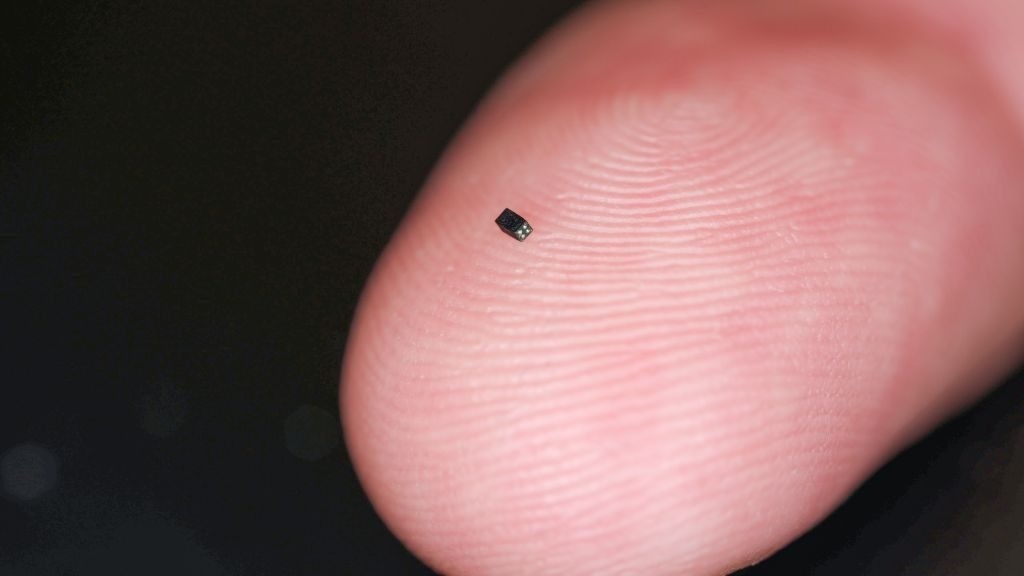
In the late 1990s, a radical idea emerged from U.S. military research circles: what if sensors the size of a grain of sand could be scattered across a battlefield, a city, or even inside the human body to gather real-time data on everything from enemy movements to vital signs? This concept, known as Smart Dust, was born from DARPA-funded research at the University of California, Berkeley. It aimed to pack sensing, computing, and wireless communication into a volume of just one cubic millimeter (1 mm³)—roughly the size of a small mote of dust.
The project captured the imagination of engineers and futurists alike. Early illustrations envisioned clouds of these microscopic devices floating through the air, self-organizing into ad-hoc networks, and transmitting data back to a central receiver. While the original DARPA program concluded in the early 2000s, its legacy lives on in modern Internet of Things (IoT) technology, industrial monitoring, and even implantable biomedical devices.
The Smart Dust concept traces its roots to a December 1992 workshop at the RAND Corporation, where military analysts explored microelectromechanical systems (MEMS) for battlefield applications. Ideas included tiny corner-cube retroreflectors for passive optical signaling and distributed sensor networks. By the mid-1990s, multiple DARPA and NSF workshops refined the vision.
In 1997, UC Berkeley electrical engineering professor Kristofer S.J. Pister, along with colleagues Joe Kahn and Bernhard Boser, submitted a formal research proposal to DARPA titled “Smart Dust: Autonomous sensing and communication in a cubic-millimeter.” The goal was to demonstrate a complete sensor/communication system small enough to be dispersed like dust. DARPA’s Microsystems Technology Office (MTO) selected and funded the project in 1998.
Pister’s team at the Berkeley Sensor & Actuator Center focused on extreme miniaturization using MEMS fabrication techniques—the same photolithography processes used to make computer chips. Early prototypes were larger (around 5 mm cubes), but the vision was clear: shrink everything—sensors, power source, processor, and communicator—into a package no bigger than a pinhead.
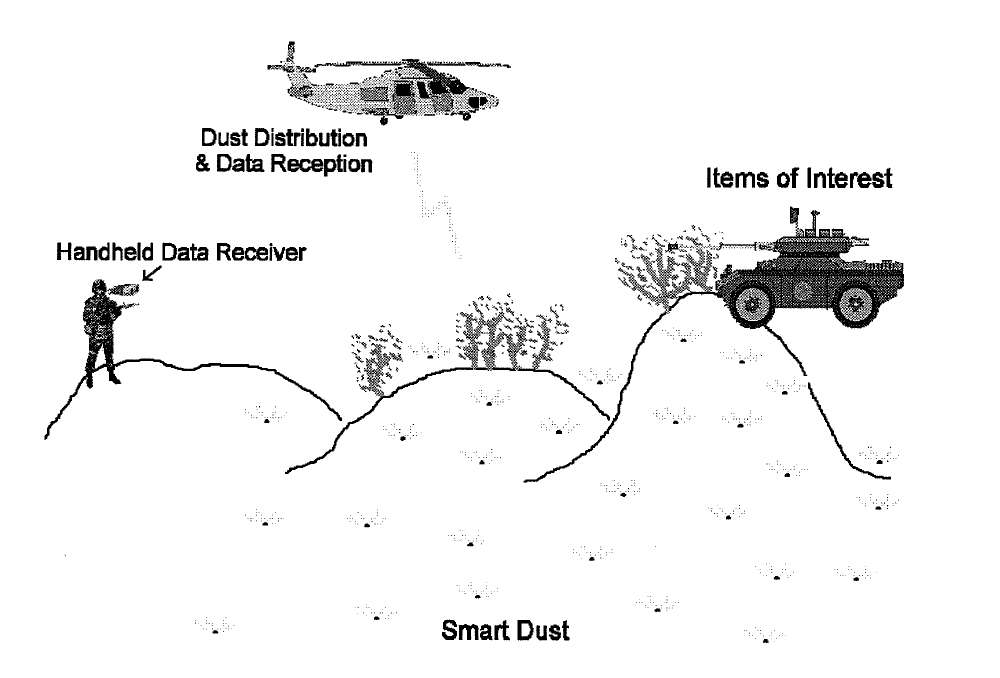
A notable 2001 field demonstration at the Marine Corps Air Ground Combat Center in Twentynine Palms, California, involved dropping prototype motes from a drone. The sensors successfully tracked the speed and direction of military vehicles, proving the concept’s viability for real-world surveillance.
How Smart Dust Works: Technical Breakdown
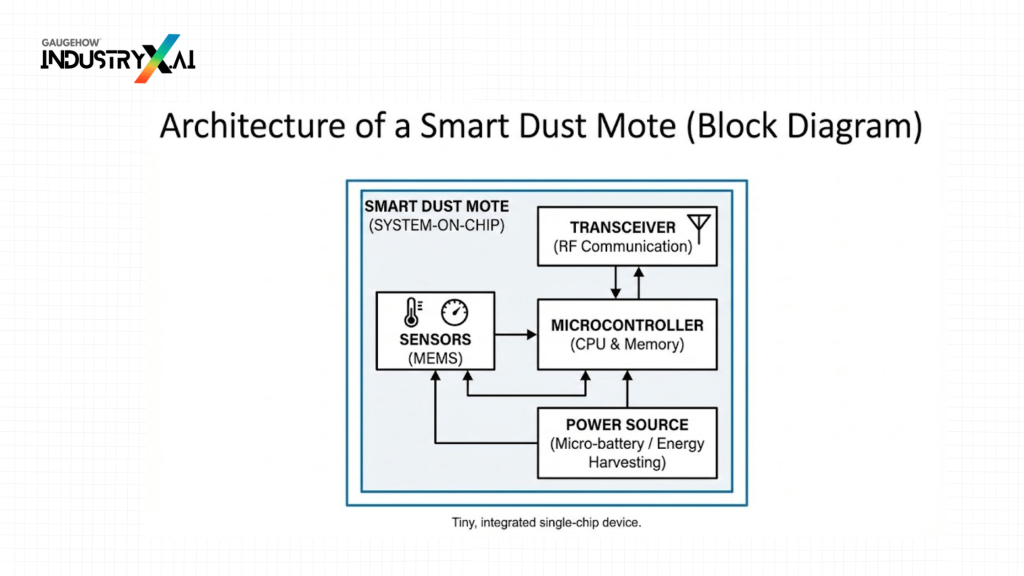
Each “mote” was designed as a self-contained system-on-chip with four core components:
- Sensors (MEMS-based): Capable of detecting temperature, humidity, pressure, light, acceleration, vibration, magnetic fields, or chemical agents.
- Microcontroller and Memory: Low-power processing (early versions used simple 8-bit cores with a few kilobytes of RAM).
- Power Source: Tiny batteries combined with energy harvesting (solar cells or vibration). Power budgets were measured in microwatts to enable weeks of operation.
- Communication: Optical links (laser diode transmitters and passive corner-cube retroreflectors) were preferred over radio frequency (RF) in early designs because they consumed far less power. Later iterations explored RF for greater range.
The motes were engineered to form self-organizing mesh networks, inspired by early work on TinyOS (an operating system still used in wireless sensor networks today). Data would hop from mote to mote until reaching a base station.
Kristofer Pister, the project’s principal investigator, became the public face of Smart Dust. His lab’s prototypes demonstrated remarkable feats, including optical communication over 21 kilometers using a modified laser pointer.

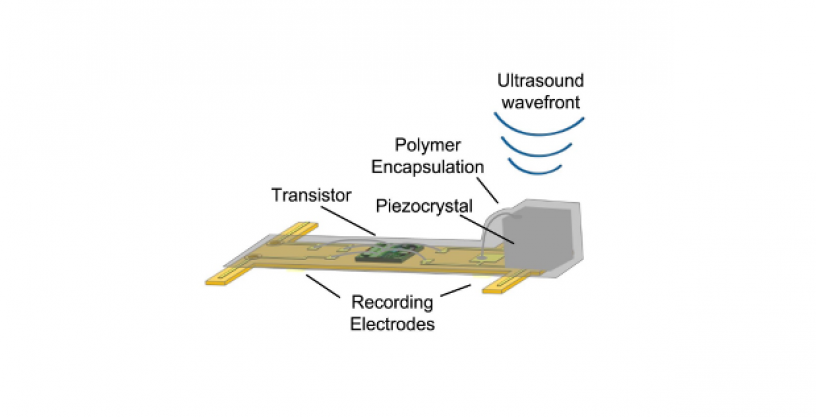
DARPA continued investing in similar miniature sensing technologies. One prominent descendant is Neural Dust—ultrasonic, battery-free implantable sensors developed in the 2010s for recording nerve and muscle activity. These tiny devices (smaller than a grain of rice) harvest energy from ultrasound waves, enabling chronic, wireless neural monitoring in animals
While the core Smart Dust research was publicly funded and much of the foundational work entered the public domain, several patents emerged from the project and its commercial spin-offs. Pister himself holds numerous patents through Dust Networks, Inc. (a company he co-founded that commercialized wireless sensor networks for industrial use).
Notable patents directly referencing or building on “smart dust” concepts include:
- US7359056B2 (2008) and US7400394B2 (2008): Assigned to The Boeing Company, these cover “responsive dust” and “co-deployed optical referencing” for optically encoded particles. The patents describe passive, nano-structured smart dust sensors that detect chemical or biological agents without onboard power. They are illuminated remotely and change optical properties to signal threats—ideal for battlefield or environmental monitoring.
- US11354666B1 (2022): A more recent patent assigned to Wells Fargo Bank, N.A., titled “Smart dust usage.” It outlines systems using swarms of MEMS devices for user authentication in payments. The “dust” particles collect biometric and environmental data (heart rate, motion, audio, etc.) to create dynamic authentication keys.
Other related patents cover transparent electronics for invisible applications (IBM, 2019) and various MEMS fabrication techniques. Many enabling technologies, such as low-power ADCs and optical transceivers, were patented by Pister’s team or licensees.
Originally envisioned for military uses—battlefield surveillance, Scud missile tracking, or chemical detection—Smart Dust has influenced civilian sectors. Commercial descendants power industrial IoT (monitoring pipelines, factories, and infrastructure), environmental sensing, smart agriculture, and healthcare.
Today, the technology is smaller than ever. Advances in nanotechnology and energy harvesting have pushed motes toward micrometer scales. Researchers continue exploring self-assembling “smart dust” particles for medicine, pollution tracking, and even space applications (orbital monitoring or planetary dust mitigation).
Critics and conspiracy theorists sometimes link Smart Dust to chemtrails or mass surveillance, but documented programs remain focused on transparent, research-driven applications with clear military and scientific value.
The original DARPA Smart Dust project ended around 2001, but its influence is unmistakable in today’s ubiquitous sensor networks. As Pister reflected in later talks, the dream was always about making computing disappear into the environment—turning the physical world itself into a vast, intelligent network.
Sources (as of April 27, 2026):
- UC Berkeley Smart Dust Project Page: https://people.eecs.berkeley.edu/~pister/SmartDust/
- Wikipedia – Smartdust: https://en.wikipedia.org/wiki/Smartdust
- Justia Patents – Kristofer S.J. Pister: https://patents.justia.com/inventor/kristofer-s-j-pister
- Google Patents – US11354666B1: https://patents.google.com/patent/US11354666B1/en
- Google Patents – US7400394B2: https://patents.google.com/patent/US7400394B2/en
- DARPA News – Neural Dust: https://www.darpa.mil/news/2016/implantable-neural-dust
- Embedded Computing Design – Early Smart Sensor Concept: https://embeddedcomputing.com/home-page/an-early-smart-sensor-concept-smart-dust
This remains an active area of research with ongoing commercial and defense applications.
What do you think?